
How to Find a Business Mentor in Ohio

First-time founders usually start the mentor search the same way: sign up for SCORE or maybe poke around the SBDC. That’s not necessarily wrong, it’s just not enough, and for a lot of aspiring business owners it’s the reason month one turns into month seven with nothing to show.
Even worse if you message people on LinkedIn or other social media platforms and ask “will you be my mentor” or “can I pick your brain?” People with real value to add through mentorship won’t respond to messages like these.
We’ll walk you through what actually works here, with the trade-offs nobody wants to tell you about.
When Free Mentorship Is the Wrong Choice
SCORE is free, there are chapters in Akron, Cleveland, Columbus, Cincinnati, Dayton, and Toledo, and they’ll pair you with somebody within a week. For many first-time founders, that’s a genuinely good starting point. The fundamentals of running a business, managing cash, hiring your first employee, closing a sale, reading a P&L, don’t really change across decades or industries. A retired operator who ran a manufacturing company in the 90s can teach you just as many business fundamentals as an active business owner.
Where SCORE can potentially get weak is the hyper specific industry details. You aren’t guaranteed to be matched with a mentor who has experience running your specific business and thus may not be able to progress you past the fundamentals. Furthermore, some first time founders need more step-by-step hand holding than others. You won’t find this with SCORE.
Ohio’s Mentor Ecosystem
Ohio has a surprisingly good startup support network. The catch is you have to know which one fits your needs:
OhioXcelerate is a statewide program for startups to connect with investors, mentors, support organizations, and each other. We take a small cohort each year (four in 2025, picked from 35+ applications) and pair you with 20-plus mentors during a structured sprint that ends at the Ohio Tech Summit in Columbus. What makes it different from most accelerators is the mentor density. You’re not matched with one person, you’re rotating through 20-plus active operators and investors in breakout rooms, which means you get a lot of different perspectives fast. Best fit if you’ve got a real product or prototype and you’re trying to get investor-ready. The downside is it’s cohort-based, so timing matters. If applications just closed, you’re waiting months. The upside is that the application itself is useful. Filling it out forces you to articulate your business in a way most founders avoid until they’re cornered.
Rev1 Ventures (Columbus): Rev1 runs a concierge model where you get matched with an Entrepreneur-in-Residence (EIR), which is usually a former founder who now spends their days helping other founders not repeat their mistakes. They lean tech, life sciences, and anything adjacent to Ohio State’s research pipeline. If you’re pre-seed to seed stage and technical, this is probably the single highest-quality mentor match in the state. The catch is Columbus-centric. They’re friendly to non-Columbus founders but the gravitational pull is real, and if you’re serious about working with them you’ll end up driving to Columbus a lot.
JumpStart (Cleveland): JumpStart’s has historically focused on underrepresented founders and Northeast Ohio specifically, and they run both mentorship and direct investment programs. What’s worth knowing is that JumpStart mentors often come attached to capital, which changes the relationship. It’s less “coffee and advice” and more “we’re evaluating whether we want to back you.” That’s not a bad thing, it just means you should treat early conversations like they’re part pitch, part mentorship. Go in prepared.
Launch Dayton and The Entrepreneurs Center (Dayton): Dayton is the most underrated startup scene in Ohio. The Entrepreneurs Center runs programming, and Launch Dayton is the broader community umbrella. The reason it works so well for first-timers is capacity. Columbus mentors are overbooked, Dayton mentors usually aren’t, which means you can get real time with experienced people instead of a rushed 30 minutes. Dayton also has deep roots in aerospace, defense, and manufacturing because of Wright-Patterson, so if you’re building anything in those verticals, this should be your first call, not your last.
Queen City Angels (Cincinnati): QCA is technically an angel investor group, not a mentorship program. But, their due diligence process is some of the best free mentorship in the state. Even if they don’t end up writing a check, the questions they ask during diligence will expose every weak spot in your business, and the partners have decades of operating experience across a ton of industries. Founders who pitch QCA and get rejected often walk away with a great idea of the holes in their business.
You Don’t Just Need One Mentor, You Need Three (Kinda)
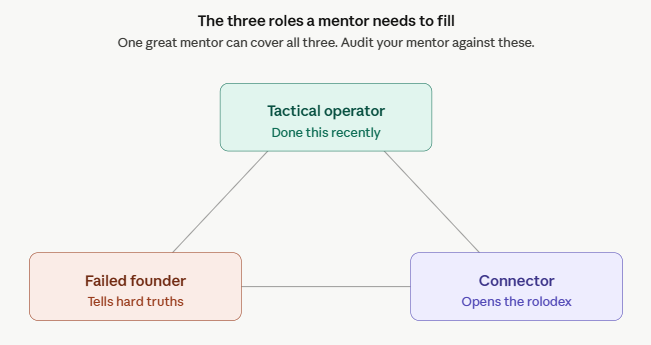
Stop looking for “a mentor” in the abstract and start looking for someone who fills three specific roles.
One, a tactical operator who’s done the thing you’re trying to do right now. Two, a been-there-failed-that founder who’ll tell you when you’re lying to yourself. Three, a connector who knows your industry in Ohio and will actually make introductions.
The good news is one person can fill all three, and the best mentors usually do. Somebody who built and sold a company in your space has the tactical chops, the scar tissue, and the rolodex all in one. If you find that person, you don’t need anybody else. Seriously, stop shopping.
The problem is most first-time founders never audit whether their mentor actually covers all three. They get paired with a nice person, have a few pleasant conversations, and six months later realize they’ve gotten zero introductions and zero hard truths. That’s not a mentor, that’s a coffee buddy.
So before you commit, ask yourself honestly: is this person giving me tactical advice I can use this week? Are they willing to tell me I’m wrong? Have they made an intro yet? If two out of three are missing, you don’t need to fire them, you just need to add somebody who fills the gaps. Maybe that’s another operator, maybe it’s a paid coach, maybe it’s showing up at a Rev1 event until you meet the right connector.
The OhioXcelerate cohort structure forces this audit because you rotate through multiple mentors in breakout rooms, and you quickly notice who gives you something useful and who doesn’t. That’s not an accident, that’s the design working.
Paying Might Be Cheaper
Free mentorship isn’t free. It costs you time, and when you’re burning runway, time is the one thing you can’t replace. We’ve seen founders spend six months cycling through volunteer mentors to save $2,000 while their competitors paid an industry-specific coach and hit product-market fit three months earlier. Do the math on your own burn rate before you commit to the “free” path. Don’t ask “what’s the cost?” ask “Is it worth it?” Sometimes $300 an hour for the right person is the cheapest thing you’ll ever buy.
Paid Mentorship Communities: The Hybrid Nobody Talks About
There’s a model that sits between “hire a private coach” and “hang out in free online business groups” and it’s worth understanding because it might actually be the best fit for a lot of first-time Ohio founders.
The setup usually looks like one or two experienced mentors run a paid community, you pay to join (sometimes a one-time fee, sometimes a subscription), and in exchange you get access to the mentors through group coaching calls, office hours, plus access to a community of other founders who also paid to be there. Most of it runs virtually, which for Ohio founders is actually a feature because you’re not limited to whoever happens to live in your city.
The economics are the part most people miss. A good private coach in the startup world runs anywhere from $200 to $500 an hour and up. If you need ongoing access (and you do, because the questions never stop), that adds up fast. A paid community might cost you a few thousand one time, or $50 to $200 a month, and you get mentor access plus a bunch of other stuff on top. For a bootstrapped founder watching every dollar, the math on long-term access is just better.
But the real reason we push this option harder for first-timers isn’t the money. It’s the loneliness.
Starting a business is brutal in a way that’s hard to explain to people who haven’t done it. Your friends and spouse don’t fully grasp what you’re going through so who can you talk to about it? This is when founders quit, and most of the time it’s not because the business was bad. It’s because the isolation got to them.
A community of people who are going through the exact same thing fixes this in a way a once-a-month mentor meeting just can’t. Somebody posts in the group about losing their biggest prospect and five people who lost theirs last month respond. You post about a pricing question at 11pm and wake up to three thoughtful answers. That constant contact with people who “get it” is the thing that keeps momentum going when motivation runs out.
The other underrated piece is the quality filter. Free communities are full of tire-kickers and people who joined in a burst of enthusiasm and then never came back. When people pay, even a modest amount, the population shifts. The members who stick around tend to be further along, more serious, and even more willing to actually help you. It’s not a perfect filter but it’s a real one, and it shows up in the amount of action being taken and the quality of conversations pretty quickly.
A few things to look for before paying for one of these:
Is the mentor actually showing up, or is it a brand name who hired a team to run the community? Check their recent posts and calls.
Is there a genuine community layer, or is it just a content library with a Discord tacked on? The community is the whole point.
Is it focused enough to be useful? A community for “entrepreneurs” is too broad. A community for B2B SaaS founders doing under $1M ARR, or for e-commerce operators scaling past $10k a month, is the kind of focus that actually moves the needle.
Is the mentor actively in their business or did they decades ago?
The trade-off is that paid communities aren’t local. You’re probably not going to meet your Ohio investor through one. That’s fine. Use the community for the day-to-day coaching and the emotional load, and use the Ohio-specific programs (OhioXcelerate, Rev1, Launch Dayton) for the local network stuff. The two layers don’t compete, they complement each other.
Interested in becoming a mentor for OhioXcelerate or pitching you business? Apply here!